Sunday, October 12, 2014

Crazy Cool Festival Links Healing Arts and Political Action in Fight Against Stigma of Mental Illness

"The arc of the moral universe is long but it bends toward justice." So said Martin Luther King, Jr., quoting the 19th-century abolitionist Theodore Parker.

On Saturday, October 11, from 10 AM to 4 PM, Community Links, the young adult program of the mental health agency, Baltic Street AEH, sponsored a "Crazy Cool Festival" in Prospect Park, sharing the message with more than a hundred participants that the oppression and stigma faced by people living with mental illness are often worse than the dis-ease itself.


Defying the blues on a gray day

In an act which defied dark clouds and occasional rain, Community Links established a "stigma-free zone" in an encampment of pop-up blue tents, ringing the plaza next to the park's band shell at 9th Street, where mental health consumers, family members, friends, and curious passers-by engaged in healing arts to celebrate their full human potential and expressed their desire for social and political action against trauma of all kinds.

Speaking on behalf of her staff, volunteers, and everyone in attendance, Yasmine Kamel, project director of Community Links, set the tone with the following address:

"The odds are that you or someone you love has struggled with their mental and emotional health. That struggle does not change the fact that they are as full of potential as anyone else and as deserving of inclusion and opportunity as anyone else. Yet, people who identify with these challenges encounter stigma in all walks of life, from stereotypical media portrayals, to open discrimination and exclusion in social and professional spaces. [Today is a day to discuss, learn, and celebrate] the uniqueness, beauty, and power of our community! [Educate yourselves] about the forms of [stigma which] impact people labeled .. or identifying with mental health conditions; and how you can work to fight and end them!"

Mike Veny of Transforming Stigma (www.transformingstigma.com) and Sascha Dubrul of the Icarus Project (www.theicarusproject.net) added words of wisdom based on their experiences of being considered mentally ill. They defied society's perception of risky behaviors by recounting how they stretched their personal boundaries through musical and theatrical performances; thereby finding support from like-minded people.

Sascha "Icarus" Dubrul has landed

Jenna Ritter of DHARA (www.dharanyc.org) stretched muscles with breathing exercises and gentle movement as an introduction to her "Six Weeks to Wellness" course developed at  the National Alliance on Mental Illness (NAMI NYC-Metro), which "lays the framework of yoga healing principles for mental health in an experiential and practical way." 

In an artistic vein, Juan Nolasco, of Healing Arts Initiative (HAI) instructed audiences how to make mandalas, intricate patterns which represent wholeness and symbolize one's journey through life. He presented examples of his own digitally-transformed acrylics on canvas. (Contact him at nolascojuan51@yahoo.com.)


Juan Nolasco's "Neon Medusa"

Elizabeth Paulus was another art exhibitor. Her watercolor prints ranged from portraits to still lives. (Her contact: woolylambart@yahoo.com.)

"Pharmacy" by Elizabeth Paulus

For those who wanted to share their emotional journeys on paper or out loud, the following workshops were opportunities for story-telling:

Kristin Richardson Jordan (KristinRJordan@gmail.com) of Uproar Poetry stimulated would-be poets to list insults and compliments they had faced. She distributed Maya Angelou's famous "Still I Rise" as an object lesson:

You may write me down in history
With your bitter, twisted lies,
You may tread me in the very dirt
But still, like dust, I'll rise...

Kassandra Whittaker (kwhittaker@communityaccess.org), of Parachute NYC, a new group of respite centers throughout the city for people experiencing emotional crises, invited passers-by to speak out against stigma by telling their own tales of discrimination.

Through its "I Will Listen" project (www.iwilllisten.org) and the affiliated "Hearing Voices NYC," (www.hearingvoicesnyc.org), NAMI NYC-Metro, in the person of Dana Daugherty (outreach@naminyc.org) gained commitments to support family members in need of mental health services and be more tolerant of easily-misunderstood "symptoms."

NAMI listens and learns

Michael Murphy of Peaceworks/Anti-Violence Project (www.avpusa.org) passed around a transparent plastic ball with suggestive, but incomplete slogans, such as "the most helpful  thing I've done was..." By selecting whichever one caught their attention, participants took turns testifying who they are and what they do. 

Peaceworks promotes alternatives to violence

The booths of Raise the Age NY (www.raisetheage.ny.com), Youth Organizing to Save Our Streets (www.yosos.org), and the New York Association of Psychiatric Rehabilitation Services (www.nyaprs.org) stood as venues of political theater (or "agit-prop"). The first seeks to raise the age of criminal responsibility from 16 to 18; the second, a project of the Crown Heights Community Mediation Center, weighed in against violence and trauma. The last requested petitioners to condemn the coercive Families and Mental Health Crisis Act proposed by Congressman Murphy (R-PA).

Although the skies did not clear by afternoon's end, nor the heavens rejoice with hosanna's of praise, Community Links had demonstrated folks with behavioral health challenges know how to care for and inspire each other to new heights. Its staff and volunteers proved to be able do-it-yourself'ers in recovery from mental illness and substance use conditions, with two years' experience hosting open houses to inform potential clients of resources throughout three boroughs.   

Community Links's mission is to help "participants improve their quality of life by achieving independence and self-sufficiency, through community participation and integration. [They] work with young adults 18-25 years old residing in Brooklyn, Queens, and Staten Island, who are living with psychiatric diagnoses or struggling with substance abuse."

[They] offer:
  • Peer support and hands-on assistance in establishing and maintaining connection to community resources;
  • Collaboration on setting short-term and long-term goals;
  • Referral to essential services, such as advocacy and [treatment];
  • Connections to health-related work groups and [advisory committees], as well as meditation, aerobics, and other exercise/healthy living classes;
  • [Help finding] educational resources (e.g. computer training, GED classes, college prep, and [other] skills training);
  • Group workshops on recovery and socialization;
  • [Information about] peer-led and other support groups; and
  • Vocational counseling/volunteer opportunities. 
(See Community Links's brochure, "Embrace, Empower, Evolve! Empowerment through Community Integration," by contacting them at (929) 210-9810 or communitylinks@balticstreet.org.)


Thursday, May 8, 2014

Steve Weisman Bets on a Car Fueled by Faith and Recovery


We meet in a Dunkin Donuts, near Steve Weisman’s “program” at the Jewish Board of Family & Children’s Services (JBFCS) on Coney Island Avenue, just north of Kings Highway, in Brooklyn.


With a whorl of white hair on his head, matching trim beard, and wire spectacles perched on his nose, Steve resembles a modern-day “tzaddik” or wise man.


He buys me a cup of coffee—I refuse a donut—because generosity is part of his nature. America may run on Dunkin, but we’re here sitting on stools to discuss the often bittersweet subject of “faith and recovery.”   

 MelBrooksApr10.jpg
Mel Brooks, Steve Weisman's crony

Steve would never pretend to imitate Mel Brooks’s rendition of the “2000-year-old man.” Nevertheless, he is fond of scriptural-like irony, and paraphrases the lyrics of that major musical deity, Bob Dylan, who accuses the listener “You ain’t lost your faith; you never had any,” on the song “Positively 4th Street.”


Or there’s Steve’s quip, “How many psychiatrists does it take to screw in a light bulb? That depends on whether the light bulb wants to change itself.”


These two insights bracket Steve Weisman’s life, one of mental illness from an early age, when he “ditched the theory” that all was right in heaven and on earth. He more or less wandered alone in a faithless wilderness for 40 years.


However, when his two sisters and brothers-in-law turned to Orthodox Judaism in the early 1990’s, their example rubbed off on him: “I thought about everything I’d been through and decided I needed to be more conversant with my tradition. I began to think about religion, life, God, the universe…how things happen.”


Steve was attracted to the meaning of suffering in Judaism, particularly in terms of his own life. He began to understand that suffering can bring you closer to God by identifying with the plights of other people, a notion which reminds him of the book, “When Bad Things Happen to Good People,” by Rabbi Harold Kushner.


Then, through “mitsvot” or good deeds, you may alleviate suffering; thereby empowering yourself in the service of God. This thinking may sound circular, even paradoxical, but that’s what faith is all about.


If this reasoning also seems like a self-fulfilling prophecy, everyone who has survived bouts of mental illness knows recovery is like an engine that needs a constant supply of gas—an image Steve appreciates because he can tell you the horsepower, not to mention the fuel efficiency, of every car on the market.


Like Albert Einstein’s famous maxim, “God does not play dice with the universe,” Steve is equally emphatic: “God is not lax; he’s not oblivious to what goes on; He’s just and merciful. If you rob banks or mug people, there will be a reckoning.”


This transformation of his attitudes about things earthly and divine over the last 20 years has alleviated some of the sadness and uncertainty from his earlier days. Steve explains, “It has set the table for what I have to do. I’m a Jew with mental illness, and I have to be the best person I can be. I try to help others on a daily basis. I’ve never been good at planning the future.”


Through his work as a peer counselor, his loyalty to friends, and his compassion for the members of his self-help program at JBFCS, he’s on the road not only to recovery but also to “discovery of who I truly am.”


Then, Steve lowers his voice, as if to say out loud the following will jinx him: “If I ever relapse to the point where my only resource is the program, my belief in myself and in God will give me the strength to try something else, to put something forward. It’s a nascent belief that hope will grow.”


Or as Mel Brooks might say in a Yiddish accent, “Stick to your shtick, boychik, and you’ll go far.”

Friday, October 4, 2013

440 Gallery: Collective Breaks Art-Making Ground in Park Slope


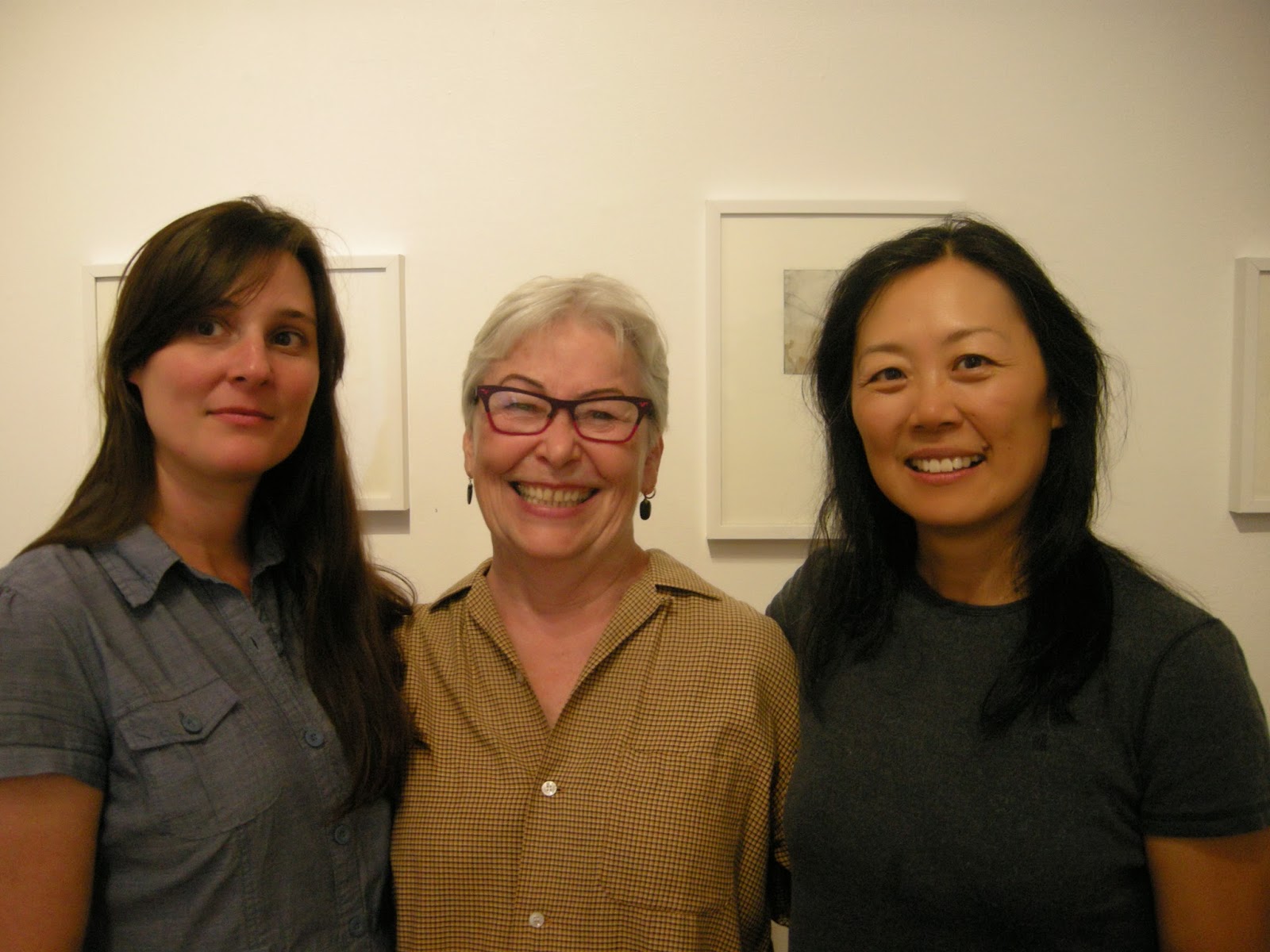
Amy Williams, Gail Flanery, and Ella Yang (l-r) are three of the 14-member art collective, 440 Gallery


Small Storefront Packed with Artists and Their Ambitions

There's no impresario behind the 440 Gallery (440 Sixth Avenue in Park Slope) as Alfred Steiglitz was the driving force at "291" (291 Fifth Avenue in Manhattan) in the early 1900s. That's because a century later the 440 Gallery is a collective of local artists beginning to reach a wider audience.

Yet, like Steiglitz's goal of promoting an American and European modernism that had not yet rejected representation (or realism), the artists of "440"--proficient in drawing, printing, painting, photography, sculpture, and installation--are as accessible as they are adventurous. Their goals are to sell quality work and encourage a public conversation about art and the imagination.

Founders (in 2005) Nancy Lunsford and Shanee Epstein, plus Vicki Behm, Fred Bendheim, Tom Bovo, Ellen Chuse, Gail Flanery, Jay Friedenberg, Laurie Lee-Georgescu, Karen Gibbons, Susan Greenstein, Katharine C. Hopkins, Amy Williams, and Ella Yang achieve these dual objectives mainly through regular rotation (every six weeks) of their work, other cultural events to attract people to the gallery, and, especially, through their Young Artists @440 series. The latter program, run by Vicki Behm, engages children in art-making and appreciation.


"Highline flowers and rooftops" by Susan Greenstein
 
 
Postcard by Phil DeSantis

The current exhibit, mounted in front through October 20, is Paesaggio (Italian for "landscape"), of works by Susan Greenstein and her husband Phil DeSantis, which are respectively whimsical oil pastels and impressionistic watercolors. The painters' subjects are both urban and pastoral; sometimes a mixture of the two. Whatever the focus, the colors are bright and the mood optimistic. 

Susan Greenstein and Phil DeSantis

In back are Gail Flanery's monotypes and prints resolving perception into horizons of color, the ominous strokes of oil stick, paint, and graphite on heavy printmaking paper by Katharine C. Hopkins, who uses them to depict decrepit piers, and Tom Bovo's photographs of leaves, which resemble vivacious botanical specimens. (Bovo's pieces preview his Genius Loci show, October 24-December 1.)


Monoprint by Gail Flanery


"Pier, No. 1" by Katharine C. Hopkins


Tom Bovo's "Untitled" (l) and "Untitled, Red and Green" (r) 


Young Artists @440 Make Their Marks

This reporter is most intrigued by Young Artists @440 because it brings art down (or up) to kids' levels, depending on how sophisticated they are in their understanding. First, they discuss their reactions to the members' works on display. Then, with those thoughts and feelings for inspiration, the children employ different media to express their visions of what the art means.

By Susan, Young Artist
I imagine the young ones showing off their creations to their parents,  and, as if in a grocery store aisle, urging their moms and pops to buy the art on which their own work is modeled. In fact, the experience for the young artists is not a matter of judging whose opinion is right or which art object is best, like choosing a brand name or examining the ingredients on the box; rather, as Gail Flanery emphasizes, the goal is to "give kids the confidence [to express] what they see in the work. [The program] gives them access." And, it just may be, that parents learn a lot from their babes, who are more open to wandering in the proverbial artistic woods.
 
Collective has Sound Organizational Model

The other side of this coin of engagement with the public is the operation of the collective itself. Members are accepted not just on the strength of their art but also on their willingness to work together as volunteers. Diversity of backgrounds and styles is another goal.

Among the requirements: everyone gallery-sits during each other's shows; everyone contributes according to his or her abilities and the gallery's needs. This means everything from sweeping floors and hanging exhibits to writing press releases and maintaining the website (including a well-written and informative blog). Tasks are rotated periodically to avoid drudgery.

Now at its limit of 14 members, 12 of whom live or work in Brooklyn, 440 is smaller than many artists' collectives in Manhattan and more user-friendly than commercial galleries. 

Ella Yang touts its intimacy: "Each artist gets their own solo exhibit at least once every two years, compared to once every three at the big collectives. You have complete artistic freedom to try anything, to use the gallery space as you wish during your solo show. In other words, you don't have to meet the expectations of a commercial gallery director about what you make and show. Plus there's a built-in support team, so when tasks aren't taken care of, it's hard for the under-performing members to hide." 

"Untitled Grouping" by Tom Bovo

This commitment to art grounded in daily life, neither as an abstract exercise or a commercial enterprise alone, makes the democratic give and take of a collective worthwhile. The involvement of the artists in the operation of the gallery also builds relationships with the surrounding community.

Amy Williams enthuses "the public has more access to artists here. They can bounce ideas off us because we're sitting in the gallery during receptions and regular hours. We're a community of trust; we put forth each other's work equally."   

By building this solid organizational foundation, the gallery has enhanced its local reputation via two yearly exhibits involving calls for national entries, and using outside judges-curators. One displays up to 70 reasonably-priced, small works immediately after 440's winter holiday weekend sale, with items ranging from $4.40 to $440! The other is a theme show. For Earth this past summer, 13 objets d'art were selected from 600 submissions.

To skeptics who believe collectives represent a bygone era (which some baby boomers would rather forget), the 440 Gallery demonstrates efficiency with a human face. Each member has his or her drawer of samples in a flat file well arranged for browsing and sale. But this is more than coffee-table stuff. Here you see the pieces of the puzzle that make up the working lives of 14 women and men  who, luckily for the rest of us, are fine artists.

The 440 Gallery, 440 6th Avenue, Brooklyn 11215, is open Thursdays and Fridays, 4-7 pm; Saturdays and Sundays, 11 am-7 pm. The closing reception for Paesaggio is Sunday, October 20, 4:40  pm. For more information, call 718-499-3844 or go to www.440gallery.com.  

Thursday, October 3, 2013

Community Links Encourages Cultural Expression to Enhance Mental Health of Young Adults


Larisa Grinspan, Administrative Assistant, Yasmine Kamel, Program Manager, and Laurenda Lynch, Vocational Counselor for Community Links


A service of Baltic Street AEH (Advocacy, Employment, and Housing), Community Links is a kind of outward-bound for urban youth striving for mental health and a life free of substance abuse. Not that its clients pitch tents in Prospect Park for nature therapy. Rather the program has three reasons why it’s heading in the right direction.


First, Community Links claims to be unique for New York City in meeting the needs of 18-25-year-olds living with mental illness and substance abuse by providing them services “beyond clinical treatment.”


Second, the program’s staff members are peers, both in age and diagnoses, of the clients they serve. (Thus, it gets a little confusing when “peers” refers to both; you have to distinguish between the two by context.)


Finally, although the project is located at 1111 St. John's Place in Crown Heights, you might mistake it for an insurance office, with its desks aligned in neat rows; thus, discouraging more than a few peers at a time from hanging out there while searching for referrals in this neighborhood and beyond.


For, although Community Links is called a “recovery center” in City Department of Health and Mental Hygiene lingo—DHMH generously funds the center—it is more appropriately termed a “center without walls” or the starting point for the “city as community” because the goal, as Yasmine Kamel, program director, describes it, is “for peers to spread out and explore” the rich possibilities New York offers them in self-expression, education, vocational training, and jobs.


Since opening in March 2013, Community Links has welcomed several hundred guests to bi-monthly open houses at various co-sponsoring agencies in Brooklyn, Queens, and Staten Island, “showcasing resources in the community and providing clients with an opportunity to utilize them.” Community Links also organizes trips, workshops, and community discussions; all of which, like the receptions, are free and open to the public. This encourages residents, whether struggling or well, to support each other.   


Among the participating groups were Art Lab, HAI Art Studio, New York Public Library Youth Program, Black Women’s Blueprints, Everything Goes Book Café, Long Island City Roots Community Garden, Save Our Streets Crown Heights, and Opportunities for a Better Tomorrow.


Ms. Kamel attributed the success of the events to a mix of substance and style. The topics of “wellness, food and health, fitness, activism and community, visual arts, education, and poetry” naturally appeal to this age group. Plus the hands-on approach, including demonstrations and audience participation, made for a more effective learning experience.
 

Painting (2012) by Chiquita Montgomery, Community Links Peer Recovery Specialist
 

These events also help market Community Links’s long-term recovery service which matches individuals who self-report with a diagnosis to peer recovery specialists. The workers help their client-peers identify goals and tools to achieve them. Currently 30 people receive such assistance; the program has openings for more.


Education, vocational training, jobs, and parenting have been the main concerns of participants thus far. As a result of referrals to Medgar Evers College, Opportunities for a Better Tomorrow, and others, several peers have gained retail, food service, and administrative positions; one is training to be a home care attendant.


Kamel emphasized that too often young people become alienated and isolated. What they want is peer support for their creative passions. She added, “Here we don’t emphasize labels. We focus on assets rather than deficits by helping peers reach their goals and dreams. Thus, we discourage hopelessness and helplessness. [In the process] we fight stigma and promote holistic recovery.”


She continued, “Young people are open to creativity. It’s a good way to make connections with others. Through expression we come into our own beings, understanding ourselves and others. Creative communities are diverse, talented, knowledgeable, and innovative. These capacities are often underappreciated. Here, we encourage our peers to find the opportunities and means to use them.”

 
Painting by Anonymous, Baltic Street AEH, Resource and Wellness Center


Finally, Kamel, who prior to this position was program manager of Baltic Street AEH’s Resource and Wellness Center in Sunset Park, shared what might be a secret to some people: “My guess is that a little quirkiness is an aspect of creative communities. With the varieties of personalities and thinking you find, there is more understanding of the role emotion plays in our lives.”


Why did DHMH fund a program for which achieving your potential as a whole human being is more important than just surviving with a diagnosis of mental illness?


According to Yasmine Kamel, Baltic Street AEH has a reputation for successful innovation. And you might say that, in this virtual age, a recovery-center-without-walls is the cutting edge of that innovation. In addition to the many electronic means Community Links employs to communicate with its followers, Twitter will be next on the list of connections. So stay plugged in!


Community Links can be on reached on Facebook at Community Links NYC or at 929-210-9810. With headquarters at 250 Baltic Street in Cobble Hill, Baltic Street AEH runs 16 programs throughout New York City. For more information, see www.balticstreet.org or call 718-855-5929.


ebook.

Monday, September 16, 2013

Sondheim's "Company" by Gallery Players Proves Brooklyn is NEW New York

Bobby's birthday gift from his "Company"


[From time to time, I will upload to this blog articles I've published or written before on autobiography; nature; art, music, and dance; theater and film; poetry; other literature; urban planning; science and religion; and mental health. Here's a piece that wasn't published because Super Storm Sandy pre-empted all other coverage of events:]

 
When "Company" was first produced on Broadway in 1970, with music and lyrics by Stephen Sondheim, and dialogue by George Furth, the setting was "NEW YORK CITY," the time: NOW. Of course, New York City was synonymous with Manhattan then, especially when you realize "company" had the double meaning of not only the hero bachelor Bobby's circle of married friends but also how Bobby's social life was a kind of rehearsal for...if not marriage, what? Perhaps he could play the swinging single forever!


NOW that Brooklyn is the new Manhattan, it's easy to imagine "Company" taking place in Park Slope. So it's doubly a propos that the Gallery Players, at 199 14th Street, between 4th and 5th avenues, is staging this musical comedy Thursday through Sunday, November 8 - 11. And although the individual efforts of the actors on October 21 (pre-Sandy) may not have equaled the gold standard of the 2007 Tony Award-winning revival cast, the overall performance was as high-spirited as an audience could desire. In fact, the physical limitations of this 120-seat venue were the mother of many inventions, especially in direction, set design and choreography.


While the show is famous for such solos as (It's the) "Little Things" (you do together), "Another Hundred People" (just got off of the train), (I'm not) "Getting Married Today," and (Here's to) "The Ladies Who Lunch," which pack as much verbal punch as possible into a musical score, it's the ensemble pieces that make "Company" live up to its name.


The Gallery Players' rendition of the opening, title number is pitch and picture perfect: "Phone rings, door chimes, in comes company!/No strings, good times, room hums, company!/Late nights, quick bites, party games, Deep talks, long walks, telephone calls,/Thoughts shared, souls bared, private names, All those photos up on the walls..." So much so that they almost set an impossible standard for themselves to follow.


With Bobby at center stage in his cage of an apartment, he conducts, like a maestro who knows the score all too well, the greetings of the couples ranged around him on his 35th birthday. As his friends figuratively come into his life, they literally roll out the walls of his apartment and descend from a frosted-glass balcony, behind which sits the orchestra like musical window-washers ably conducted by Charlotte Evans. Such economy of execution is the mark of a director, Andrew Block, and scenic designer, Kathryn Lieber, who have their act together.


In "Have I Got a Girl for You," the five husbands who are Bobby's peers try to woo him with dance steps as nimble as such lyrics: "She's into all those exotic mystiques: The Kama/Sutra and Chinese techniques. I hear she knows more than/seventy five.../Call me tomorrow if you're still alive." This is one of several examples when Melissa Riker's choreography is at its best but sometimes she relies too much on spoofing oldtime Broadway moves.


Of course, Bobby has his tried and "true" ways. Sleeping with the stewardess April conjures dreams of women in nightgowns coming out of the woodwork and snaking around his bed. Whether these are meant to be the wives dressed similarly in the previous scene, who lamented Bobby's poor choices in women, or merely a nightmarish reminder of all his one-night stands, it is another ingenious bit of staging, if only because the confusion also foreshadows Bobby's ultimate willingness to "make it" with Joanne, the most jaded of his married friends, (Granted they are both drunk at the time.)


The challenge for any actor who plays Bobby is not only his detachment from his friends and lovers but also from his own ambivalent feelings. How do you demonstrate the slow, stumbling growth of the character toward a self-awareness that depends not on the mere choice between being single or married but on the commitment to feeling deeply or really "Being Alive," as Bobby croons in the end?


It's hard to tell whether David Schoonover is opting to be a slow starter or lacks the subtlety of expression necessary for the role. However, he makes up for this ambiguity with a singing range that reveals Bobby gradually embracing his own potential.


Another possible difficulty is a tendency to overplay the comic routines. (I'm not) "Getting Married Today" is one of the funniest because it sounds like one of those declaimers in which the fine print is crammed at the end of a commercial. Sarah Stevens as Amy clearly gulps the lines down but is too hysterical (psychologically). Likewise, Diana Rose Becker's April is too cloying in her babbling foreplay with Bobby yet in parting the next morning for "Barcelona" she finds the right note of musical coyness.


Darcy Yellin and Cindy Marchionda also preen for laughs now and then. However, Yellin generally plays Marta, the Puerto Rican pistol, as just hot enough for the audience to handle and Marchionda keeps Joanne's drunkeness in cheeky check on (Here's to) "The Ladies Who Lunch."


In a play where the men are foils for their more colorful wives, and Bobby is in over his head with his girlfriends (who serenade him "You Could Drive A Person Crazy"), it's easy to conclude that the women in the cast, also including Debra Carozza, Dana Domenick, MargareEllen Jeffreys, and Katie Johannigman, are the stronger performers. This is reinforced by the evidence that, with the exception of David Schoonover, they are the better singers and dancers. But Chris Caron, Thom Christensen, Dominic Cuskern, John Gazzle, and Greg Horton hold down the marital fort with aplomb.


Finally, Bobby's comings and goings are framed by his friends gathering for a surprise birthday party in his apartment. Even theater-goers who have seen "Company" before may not remember the ending. Thus, the Gallery Players' production is well worth the reminder.


Performances are Thursday, Friday, and Saturday at 8 p.m.; also Saturday at 2 p.m. and Sunday at 3 p.m. Tickets are $18 for adults, $14 for seniors and children 12 and under. Call TheaterMania at (212) 352-3101 or go online at www.galleryplayers.com for box office purchases. You will find the theater at 199 14th Street, between 4th and 5th avenues, in Park Slope. Take the F train to 4th Avenue or the R to 9th Street. Or drive the BQE to Hamilton Avenue.

Hamilton's Beer, Wine, Food: A First for Kensington-Windsor Terrace


(Author's Note: This previously unpublished review was written in December, 2012. Since then, Hamilton's has expanded from dinner only to lunch-brunch, and a happy hour, that, as the article below suggests, is probably the restaurant's key to financial success. Although the findings here are dated, the basic "New American" fare, a la Alice Waters, plus comfort food, remains. For all its menus, google "Hamilton's.") 
 
Beer and wine joints are a dime a dozen in Brooklyn’s hippest neighborhoods. However, west of the Prospect Expressway, on either side of the border between Kensington and Windsor Terrace, “foodanistas” have been starved for nighttime gastronomic delights.

Thus, the new Hamilton’s, at 2826 Ft. Hamilton Parkway, on the corner of East 4th Street, two blocks from the F train stop, is either a dream come true or the latest of many (perhaps failed) attempts to determine just how upscale the area has become.

The Oak and Iris, a previous effort at this site, provided decent, affordable fare, but apparently closed because it became more a breakfast-lunch hangout than a dinner place. In daylight, it competed with cafes across the street; after dark, it lacked a liquor license.

Georgia and Kevin Read, the owners of Hamilton’s, are also pitching their food prices to what the market can bear. Appetizers range from $4 to $9; entrees, $12-$18. (Whatever their pretentions, most Kensington-Windsor Terrace dwellers lack the disposable incomes of those living in Brownstone Brooklyn or even nearby Ditmas Park.)

Meanwhile, being a dinner-only establishment makes them unique, and, at $6-$10 a glass, Hamilton’s beer and wine offerings pad the bottom line. Of course, these low-alcoholic-content libations enhance the dining experience, as does the decor. The dark-grained wood bar and wainscoting, chartreuse walls, and overhead fans look so natural you’d think the place was a permanent watering (and nourishing) hole.    

On a recent Saturday evening, two months after its opening, Hamilton’s was packed with a surprising mix of young and old people; mostly white, like the surrounding nabe. Can the restaurant maintain the senior set’s loyalty in what is otherwise a noisy bar scene? This will be a key test because there are still many longtime, if not lifetime, residents around here. At 61, I felt invigorated by the sense of celebration in the room, even if chemically-induced in part.

I live two blocks from Hamilton’s. The restaurant rows on Cortelyou Road in Flatbush and on Prospect Park West, in the heart of Windsor Terrace, are each a 30-minute walk away. So I have a certain (non-monetary) investment in Hamilton’s success, though a little exercise before a meal wouldn’t hurt.

To keep myself honest, I invited my wife and sister-in-law along. They were raised on bratwurst and Miller’s in Wisconsin; I, on bland kosher food and Manischewitz in Connecticut. How much years of living in New York City have refined our tastes is another test of whether Hamilton’s will fit in our personal Zagats.

We started with the draft beers. Of the 18 on tap, we quaffed five. I prefer amber ales. The Peak Organic Fall Summit Ale from Maine and the Brooklyn Post Road Pumpkin Ale fit the bill with their hints of fruitiness. My wife goes for darker brews. The Kelso Nut Brown and Davidson Brothers Oatmeal Stout (from upstate New York) compared favorably to her usual Guinness. True to her Midwestern roots, my sister-in-law gushed over Michigan’s Dark Horse Boffo Brown Ale. We agreed that our modest selection of beers alone was worth the visit. (Next time we’ll sample some of the dozen wines available.)

The dinner menu consists of about 12 appetizers and a half-dozen main dishes, plus a few specials. It’s “safely” eclectic, from mac and cheese and burgers to a salad with toasted faro (an Italian wheat product) and Korean kimchi (fermented cabbage) fried rice. This limited repertoire may initially make business and culinary sense—adequate market test, fewer recipes to master, less wastage (and no dumpster outside attracting vermin)—but could quickly become monotonous.

My wife selected one of the specials, seared tuna on a bed of fennel coleslaw, before balking at this sushi-like dish. Once the portion was fully cooked, she was satisfied, except for a suspicion the tuna wasn’t completely fresh. While my sister-in-law didn’t object to the searing of her hake, its marinade of leeks, oysters, and Shitake mushrooms in black olive oil was not strong enough to transform a mild-tasting relative of the cod family into something more to her liking. For me, the fish stew, of Manila clams, mussels, and hake in tomato-fennel broth, hit the spot. I bagged the leftover broth and fish juices to spice my own cooking.

While Brick City Bakery in Greenpoint provided the pleasantly yeasty rolls and grilled bread, Hamilton’s concocts its own desserts. Sprinkling sea salt on the flourless chocolate cake created a flavorful contrast. And the special French apple tart lived up to its name. Shared among us, the $8 cost for each was a bargain. Although I didn’t learn the brand of coffee, it lent a fine finishing touch to a meal, which wasn’t perfect, but warmed our heads and stomachs on the short walk home.

Hamilton’s is open for lunch, Monday-Friday, 11 AM-4 PM; brunch, Saturday and Sunday, 10 AM-4 PM; dinner, Sunday-Thursday, 4:30 PM-11 PM, Saturday and Sunday, 4:30 PM-midnight; and happy hours, Monday-Friday, 11 AM-7 PM. Take the F train to Ft. Hamilton Parkway, and exit at the Ft. Hamilton Parkway end of the station. Turn right onto that street. If driving, head toward Prospect Park Southwest and Park Circle, taking the Ft. Hamilton Parkway exit ramp. Or call 718-438-0488 for more information.          


Grow NYC's Youthmarket Keeps Windsor Terrace Lean and Green

It may sound like a cliché, but Grow NYC's Youthmarket, next to the Windsor Terrace branch of the Brooklyn Public Library, builds strong minds and bodies. 

On Saturday, September 14, I met workers Gabriel Carneho and Arkadydia Sefu, and Johnathan Miranda, who traveled respectively from the Bronx and Queens, and the Brooklyn coordinator of the farmers' market, Cindy Lee, at the corner of East 5th Street and Fort Hamilton Parkway. The teens were so busy serving customers, they barely had time to pose for a photo, let alone talk to me.  


Arrayed on tables under a big white tent were several varieties of apples and peaches; eggplant, zucchini, squash, and tomatoes; carrots and beets; collards and kale; red potatoes and onions; and parsley.

As with the 54 Greenmarkets Grow NYC runs throughout the five boroughs, these fruits and vegetables came from mainly upstate New York orchards and farms. However, instead of having the farmers sell their produce out of their own trucks, which takes up a lot of space, the more compact Youthmarkets can be set up on a street corner, such as the Windsor Terrace location.

They also receive their products from a clearinghouse, rather than individual farmers, thus assuring a more reliable, and varied flow of goods. There are four other Youthmarkets in Brooklyn; two in Brownsville, one in Cypress Hills, and another in East Williamsburg.   

I bought two bags full of eggplants, tomatoes, potatoes, onions, and  parsley for 14 dollars. These were some of the ingredients I needed to prepare Macedonian salad, based on a recipe in the 1992 edition of Mollie Katzen's classic, vegetarian Moosewood Cookbook.

Youthmarkets has a triple goal--to bring fresh food to underserved neighborhoods thereby increasing the market reach of state farmers, and in the process training and employing local young people in a retail trade vital to the public health.

Compared to the other locations in Brooklyn, Windsor Terrace is not an underserved community. But the sponsor of this Youthmarket is Councilman Brad Lander, a longtime advocate for low-income residents. The fact that the workers at the Windsor Terrace stand came from the far reaches of the city demonstrate Lander's commitment to serving disadvantaged youth.

I bought the rest of the vegetables I needed at the unionized Foodtown, on the corner of MacDonald Avenue and Albermarle Road. (A cause celebre in the neighborhood is a boycott of a large market, Golden Farm, which is fighting an organizing effort by its largely Mexican-American workers.) These included red and green peppers, garlic, lemons, scallions, and olives.

I varied Katzen's recipe by roasting all the vegetables, not just the eggplant, and adding potatoes and pasta. This enhanced the sweetness of the peppers and tomatoes, in contrast to the slightly bitter (unpeeled) eggplant. The starch provided a base for the taste buds, not otherwise possible with this marinaded dish. (I kept Katzen's marinade of olive oil, red wine vinegar, lemon juice, garlic, scallions, parsley, basil, thyme, and marjoram, garnished with olives.)

The Macedonian salad (two soup pots full) I provided for Brooklyn Quaker Meeting's social hour on Sunday, September 15 was completely devoured by 100 worshipers.